
Risen 2: Dark Waters Preview
-
Category: PreviewsHits: 24193

Article Index
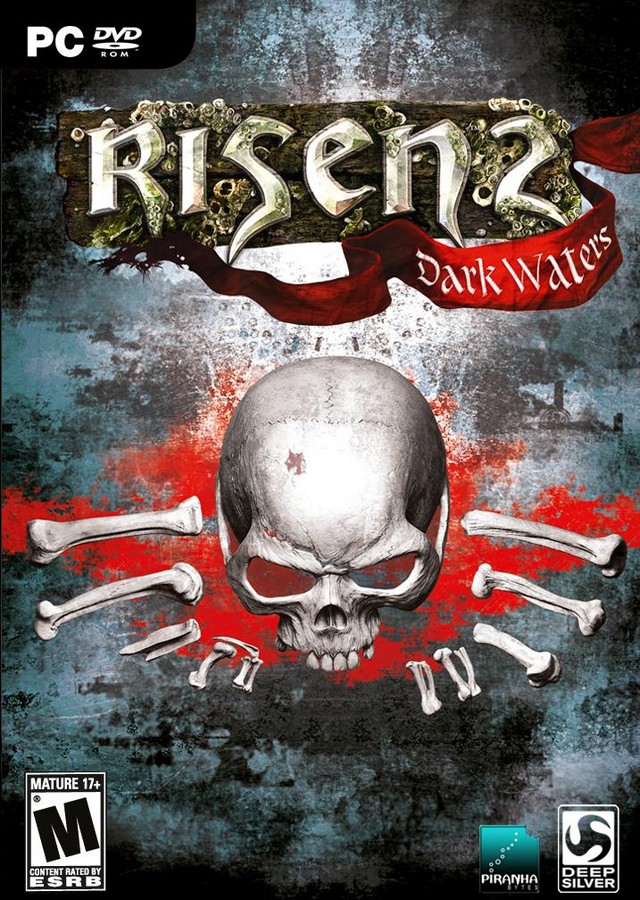
Deep Silver and Piranha Bytes recently provided us with a preview copy of Risen 2: Dark Waters that covers the game's first two regions in their entirety, as well as the majority of a third region. In all, this accounts for about a fourth of the full game, or about 8-10 hours' worth of content on a regular play-through. I sunk about 15 hours into it, but that was due to exploring every inch of the map and doing every side quest.
Story and Setting
As was the tradition for Piranha Bytes' Gothic titles, Risen 2's story follows directly on that of Risen. At the end of Risen, the unnamed player character joined the Inquisition and defeated both the misguided Inquisitor Mendoza and the Fire Titan he wished to control. The (hero) - now wearing an eyepatch to hide the ocular he took from Mendoza - is introduced sitting on a bed in the Inquisition City of Caldera, surrounded by empty bottles of rum and finishing off another one. He is called up to witness a Kraken take down an approaching ship, and sent to the beach to investigate, finding one one survivor Patty, the pirate girl from Risen.
The Inquisition leaders decide the kraken must be killed, but to do so they need a set of special weapons (as was the case to kill the Titan in Risen). To recover them, the nameless hero is sent out to infiltrate the pirates, stripped of his rank and any affiliation with the Inquisition. Patty joins up, though she has her own story going on and only follows the player out of convenience. He is sent to the island of Ticaragua, where Patty's father Steelbeard is currently docked at a small pirate's outpost. There is no real conflict or choice to make between the Inquisition and pirates there, since you're joining the pirates anyway, but it allows the player to get more familiar with both factions, and offers an initial introduction to the third faction, the savages or natives or Moluccas, forest-dwelling, voodoo-using primitives that the Inquisition uses as slave labor when they are captured. The player has to convince Steelbeard to allow him to join his ship's crew fittingly by getting the ship supplied with rum, a quest that take you all over the island, with different kinds of fetch and negotiate quests.
Steelbeard informs the player that the Titan Mara handed the weapons to two pirate captains who joined her cause. He takes his ship and the player to the Sword Coast, a coastal area mostly unharmed by the tidal waves that hit the world after the Titans were freed. There, the task is to find Captain Crow and take the harpoon from him. Crow has allied himself with the Moluccas and is holed up protected in one of their temples. A native village of the Shaganumba tribe and Inquisitor fort can be found in this area, and the player will have to join either of those factions to get past Crow's protection and face him down, and it is at that fight that the preview copy cuts off.
Piranha Bytes is getting the Gothic license back soon, and where Risen felt very much like a Gothic game, they are clearly trying to turn this franchise in another direction with Risen 2. It's not just that they added pirates; where Risen was a fairly standard low fantasy setting, the look and content of Risen 2 is very much based on the early days of European exploration in South America. The Inquisition looks and acts like the Conquistadors, slavery is widespread, and the game takes place in more of a jungle setting. Voodoo magic replaces the scroll and crystal-based magic of Risen, and pistols, muskets and shotguns are added.
The setting has a good consistency and is applied well, the factions are unique and appropriate, with the natives well-executed in accent and language, as is the look of the settlements and items for natives, pirates and Inquisition. If there's any problem, it's that the game doesn't really explain the change from Risen to Risen 2, why the Inquisition suddenly has muskets where before they did not. It's a jump of at least a few decades, if not a full century, and would have worked better had they set this years later in the decade's time line, with a new player character. But even though this is a little jarring, the setting itself is easy to get in to, and the atmosphere of the game is very well executed.
The writing in Risen 2 is quite good, with solid localization. While the story isn't really enthralling as far as the preview copy took me, and the factions not yet fully fleshed out, individual dialogs are enjoyable, cuss-word filled adventures. Risen 2 is often light-hearted in writing, with the dry-witted PC exchanging barbs with allies and enemies alike. The sense of humor is very German and may not appeal to everyone, but worked for me.
Character system
Risen 2 has a relatively simple character system, but one that is also intuitive and seems like it will give solid customization paths for higher-level characters. The character attributes are split between attributes, talents, and skills.
Attributes are the main statistic, and the only place in which you can invest Glory (the game's equivalent of experience), consisting of Blades, Firearms, Toughness, Cunning and Voodoo. The basic cost of updating is 1000 glory, with increments of 1000 for every next upgrade so upgrading firearms or any other attribute from 4 to 5 costs 4000 glory.
Talents are the abilities tested in the game world, passively derived from attributes and skills. They can not be directly upgraded. There are three talents for every attribute: Slashing Weapons, Piercing Weapons, Throwing Weapons (Blades); Muskets, Shotguns, Pistols (Firearms); Bladeproof, Bulletproof, Intimidate (Toughness); Dirty Tricks, Thievery, Silver Tongue (Cunning); Black Magic, Death Cult, Ritual (Voodoo). Most of them are self-explanatory. The Voodoo skills consist of Black Magic for the use of scepters and voodoo dolls, Death Cult for summoning ghosts to your aid, and Ritual for the usage of potions. Each point put into an attribute increases the three related talents by 5.
Skills are upgraded by the usage of trainers. Unlike previous Piranha Bytes games, this does not take any experience points; instead, it takes only gold but has a minimum requirement in the related attribute, and for certain skills you must have the preceding skill upgrade. For example, the "Muskets I" skill takes 500 gold and requires a Firearms attribute of 3, "Shotguns I" takes 500 gold and a Firearms attribute of 2, and both of those increase their related talents by 5 points. If you want "Shotguns II" (+10 shotguns talent), you will need both "Shotguns I" and a Firearms attribute of 5.
Each talent has 3 of those upgrades, which makes up 9 skills per attribute, and each attribute has a further 6 skills related to them. These are the more unique skills. For example, there's learning to parry and smithing for Blades, the ability to shoot someone mid-conversation and gunsmithing for Firearms, learning to kick, distill and even regenerate health for Toughness, pickpocketing, sneaking, lockpicking and monkey training for Cunning, and creating dolls, scepters, talismans and potions for Voodoo.
It is quite different from earlier Piranha Bytes character systems in how it simplifies the spread of updates down to spending Glory on Attributes and money on skills. The skills not tied to talents are one-upgrade only, so lockpicking and pickpocketing are simply learned and from then on depend on your Thievery talent level on whether or not you can attempt something. Failing a test in Pickpocketing, Silver Tongue (persuasion) or Intimidation isn't really possible, the PC will simply refuse to do them if you lack the requisite talent level. Similarly, breaking lockpicks has been removed, you need only one lockpick and then the required thievery level to pick open doors and chests, which takes you into a fairly simple unlock minigame reminiscent of the one from Oblivion. This minigame as far as I had got into the demo is impossible to fail, all you need to do is figure out the order in which to push up the catches, which is usually really simple.
Further evidence of simplification comes in the fact that the old system of learning how to collect trophies from animals and prospect for ore already pared down to simply (gut animals) and (prospecting) in Risen has been completely removed. Now, if you own the required item (bone saw, skinning knife, pickaxe), then you can collect trophies and ore, with gold ore being the only resource I found for the pickaxe. Crafting does require skill in alchemy or gunsmithing, as well as recipes you can buy from vendors, a system I did not get to test much as there isn't much available later in the game. Interestingly enough, the creation of healing items falls under the Toughness skill of distilling, as Rum, Grog and Bloody Maries are the healing (potions) of choice, while the Voodoo skill of alchemy is mostly involved with potions that give temporary or permanent boosts to talents.
The character screen also shows crew (which is later game content not a part of this preview) and collection. The collection is made up of legendary items you found throughout your travels. Collection items can not be sold, though they can occasionally be bought (and are really expensive). They provide a permanent boost to an attribute (for instance, a peg leg giving +1 toughness) or a talent (a hand mirror giving +10 silver tongue). You learn about these items from reading books or talking to people, and can then spend time tracking them down, or you can stumble onto them by simple dint of exploration. This along with a more varied equipment offering does compensate a bit for simplifying the character system.
Combat
Risen 2's basic swordplay is essentially the same as that of Risen, and will be your primary mode of combat for the first 10 hours or so before you get to unlock muskets or voodoo. Like its predecessor, attacking with piercing (épée) or slashing (sabre) weapons is a process of stringing together series of strikes for straightforward combos. Shields are out, but you can still block with your weapon, albeit only in combat with other humans. In combat with animals, the kick has to be employed as a defensive tool. As with most Piranha Bytes games, the combat isn't based on fluidity and quick action like the Witcher 2 or Kingdom of Amalur, but more on knowledge of the opponent's timing and types of attack, and careful attacks and counter-attacks.
The biggest problem still lies with fighting animals, which is never very involved in Piranha Bytes games. You can not block their attacks, though you can dodge some charging animals simply by moving out of their path, and kick others to create some space or even to flip over the heavily armored giant crabs. For many animal or monster types like leopards, alligators or ghouls it is too easy for them to stunlock you, as they will keep relentlessly charging you, so combat with those often involves frantic clicking to try to stunlock them instead, or jumping around to avoid their attacks. Other animals, like the claw monkeys and firebirds, spend so much time warily circling you that you can often kill them before they even decide to attack. As per usual for Piranha Bytes games, there is a reverse difficulty curve, and early combat can be a little frustrating, especially as you get the hang of the system, though getting a companion in the second area definitely helps.
One thing worth noting is that there's surprisingly little recycling of animal and monster types. The ghouls and warthogs are back, and gnomes will make an appearance later, but most monster types are new, and clearly created with the changed setting in mind: alligators, leopards and monkeys fitting the jungle better than wolves would.
While muskets and shotguns aren't available until later, pistols join the game fairly early. A pistol, throwing knife or a (dirty trick) item (like sand to throw into someone's eye) can be equipped in your off-hand, and activated by pressing E. They are primarily used to gain and advantage when the odds are against you, and can stun or damage an opponent, but they do have to recharge after use, by way of a cooldown timer. A nice addition but not much of a game-changer. They are used by enemies as well, from monkeys throwing coconuts at you to humans using pistols.
Near the end of the third area, you have to join either the Inquisition or the Natives. The Inquisition makes muskets and shotguns available to you, the Natives voodoo magic, and joining them is the only way to obtain these unique items and skills, at least at this point in the game.
Muskets and shotguns replace your main weapon if you opt to use them, and use up (very cheap) ammo. You aim by holding the right mouse button and fire with the left, or alternately if the enemy has gotten too close you can use it as a close combat weapon, though this is not usually effective unless the weapon has a bayonet. There is no real aiming involved, the game shows a very large circular reticule, and will target the enemy highlighted inside this area. Nor is either weapon particularly long-range. They rarely kill an enemy in one shot, the result of which is a fight plays out mostly by avoiding the enemy by running around in between quick shots. Stats determine your to-hit chance, as well as your critical hit chance (which can be improved by certain firearm skills), though the hit chances at close range are pretty good. Improving the skill means more chances to hit at longer ranges.
The main weapons of voodoo are the scepter and voodoo doll. The doll isn't a combat weapon, instead it is an alternate means of solving many quests by taking over the mind of a character. You can not use such possessed characters to fight, but you can learn new info by using him to talk to people, or get the possessed character to pick up items for you. I unlocked the skill very late and only got to use it once, but it has a very high potential for creative usage. In combat, you can use scepters. At a distance, they can be used to cast spells, like a fear spell that stuns opponents, and can also be used to attack with at short range simply by bashing enemies over the head with them. Whether or not you can use a scepter on an enemy depends on whether your black magic talent is high enough to match his level, which at this stage of the game was usually not the case. It's not immediately clear to me if the scepters are ever a fully viable offensive weapon or if you're meant to switch between them and swords.
Mana has been completely removed. Instead, scepter spells, muskets, shotguns and pistols all work with cooldown timers. There is no reload animation or action for the guns, they just cool down automatically, taking a few seconds for muskets/shotguns and 20 seconds for the pistol type I carried. This is one of the most curious design decisions in the game, and will probably rub a lot of people the wrong way. It didn't work all that well from a gameplay perspective either, but keep in mind I didn't get to play around with either firearms or voodoo all that much, so it really depends on how it's implemented later in the game.
Speaking of curious design decisions, the weirdest ones are these: the main character can not swim, when he enters deep water you are transported back to land. Saving on swimming animations, I suppose, but it feels odd to be a pirate who can not swim. And second, despite not being very good at animations or particle effects, Piranha Bytes decided it was a good idea to add a killcam. It wasn't, it looks absolutely horrible. It's not triggered often, only when you fight a large number of enemies does it show the killing blow on the last one in slow motion. This killcam often highlights how the sword barely makes any contact with the enemy at all, or highlights the awkward motion of the PC, so I think this is one thing best cut completely from the game.
The final thing to note for combat is the companions. Patty and others join you throughout the game, and they are immortal, though they can be knocked out during combat, and will not get up until combat is over. They are also often more powerful than you. The player gains full honor for kills made by his companions, so this is a fairly easy mechanic to abuse to get through fights that should be too difficult for you. Patty accompanies you for most of the second area (unless you make the mistake of triggering her dialog with her father too soon), while you spend most of the third area alone. The jump from fighting with companions in the second area to fighting alone in the third is pretty jarring, though companions are apparently a mainstay later in the game. I fear this the immortal companion mechanic is probably something that can easily be abused for many of the tougher fights in the game, which would be a shame.
Quests
While the character system was a bit disappointing, I was impressed by the improvements Risen 2 made to quest design over its predecessor. Where Risen was filled with overly simple quests with weird solutions, too often a (beat up this guy) one, Risen 2 does a lot more with dialog and stealth skills, and gets much more creative with its quests.
A lot of quests, especially early on, do lack multiple solutions, but often enough they're there if you're willing to look for them. For instance, to get into the Pirate camp you have to get past the pirate guarding the gate. You can bribe him, or persuade or intimidate him if you have a talent level of 15, or get him to let you in if you picked up a sugar delivery quest from a nearby watchtower, or circumvent him completely to go the other gate by way of the beach. The game doesn't suggest you can beat him up to get past him, yet if you opt to try this out, attack him and win, you'll then find new dialog opened once he gets back up, and he will let you in, suitably intimidated.
The game excels where Piranha Bytes often does. It does offer map markers for quests, but only if you were explicitly told where to find someone or something, and only for your active quest (which I didn't realize was the case early on, making me struggle to find treasure from treasure maps). There is no quest compass. For most quests, people can only give you vague hints or a rough idea on where to go, and you have to pay attention to the dialog (which is logged and easily accessible if you forgot an instruction or name) to figure out where to go.
Late in the third area, after you joined the Inquisition, you're sent out to find four members of the Inquisition to get them to accompany you. The first is somewhere in the camp and you'll know where if you paid attention to his earlier dialog with you, the second is near the butcher and you're told so, the third is out scouting but you're told who to talk to to find him. The fourth is easy to find, but his musket is missing, which sends you on a quest where you talk to all the people who have seen him as they went drinking the night before, and through several persuasion and other talent checks and correct dialog choices you discover what happened to his musket. There is no (click through dialog, follow quest marker, kill what is at the end of quest marker)-style design here.
Tech
I don't have too much to say on the technical side of the game. Each of the three areas is loaded as one continuous zone on the engine, with no separate loading for caves or buildings, and the loading times for saves are surprisingly quick. This is one of those games that doesn't save over any of its quick and auto saves, so they stack up very fast, something I hope they fix before release, as the game auto saves very frequently.
The interface is intuitive, simple and well-done, with rebindable quick keys for easy access to the inventory, the map, the quest log etc. The only quick keys that can not be rebound are the hotbar keys (1 to 0), but that's not a huge deal. Graphic settings offer a good array of options to fine-tune to the best performance, though the game did seem pretty terribly optimized, and I can't say much about the graphics as I had to turn most options to low.
Conclusion
This demo kind of cut off at the wrong moment to get a good impression of the advanced voodoo and firearm mechanics, so most of it just felt very similar to the early Risen gameplay. But it does improve even on that, with better quest design and a more unique and equally well-executed setting.
The voodoo mechanics, especially the voodoo doll cursing, has a great potential to be creatively used later in the game. Guns are relatively less interesting, but they should add more variety to combat. Tantalizingly, in the first two areas you can use cannons, and enter a first-person turret mode. Though there was nothing to shoot at for those cannons, I'm curious to see what they'll do with this mechanic later.
Sequentially unlocking areas is a little different from and more linear compared to earlier Piranha Bytes titles, though we've seen similar things before (locking off the old island early in Gothic II, for example). It means you won't be as badly overmatched when stumbling onto the wrong monster as you were in older PB games, but don't think you can just run around freely on the unlocked areas either, you will still run into significant challenges you might want to put off until later. The advantage of this approach is that you regularly enter new towns and meet new NPCs, which in my opinion is always the best part of any Piranha Bytes game.
Based on the preview areas, the sequel appears to be a solid improvement on Risen, despite the disappointing simplification in character system. It is a challenging and addictive experience, and the number of hours I poured into it just leaves me wanting for more. As long as it avoids declining into a dungeon slog as its predecessor did, this should make for an excellent addition to the Piranha Bytes library.