
Torment Need Not Be Eternal
-
Category: EditorialsHits: 19191

Article Index
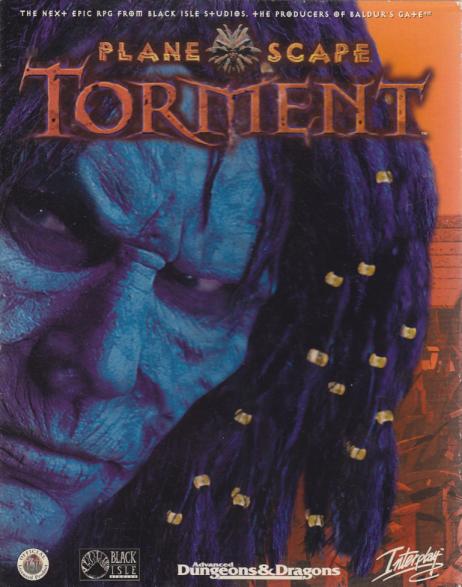
Planescape: Torment is one of those games that's able to elevate a discussion simply by its inclusion. Although highly divisive among some players, broad consensus affirms it as one of the foremost bastions of storytelling not just in role-playing games, but in gaming as a whole. Not only does it take place in one of the most inventive and genuinely interesting Dungeons & Dragons campaign settings, but it has enough interesting characters, scenarios, and organizations to fill a dozen other titles. What are incidental details in its world boast more depth and development than the main concepts of many other titles, and the sheer number of options available in dialogues, the number of unique characters, the variety in creatures the player meets, and creativity of design in the locations, sets it apart from any other game. It's a product of love, care, attention to detail, and passion for role-playing games, and it shines through not just in the game itself, but in how fondly remembered it is by its fans.
As I mentioned above, Obsidian's Feargus Urquhart had some candid words to share regarding his thoughts on a potential sequel to Planescape: Torment. I share them below for the benefit of readers:
- "I remember right after finishing Planescape: Torment I spoke to Chris Avellone [Obsidian creative director] and asked what he wanted to do, and he was like, '˜I don't wanna do a sequel!' We haven't talked about it in ten years, but it might be different now. But a lot of revisiting old games is about saying, '˜okay, that worked in 1999, what would work now?' And how would you do it again?"
"We'd have to think a lot about it, because it would have to be done right, otherwise the fans of the original would be pissed off and new people wouldn't get it. That would be terrible."
To begin, in all fairness, I'd like to reiterate that Obsidian have not confirmed they are working on a Planescape: Torment sequel, nor have they confirmed they have any plans to do so. This comment by Feargus comes during an interview in Play magazine, when asked about games he would potentially want to revisit. Rumours have abounded recently about whether Obsidian would be revisiting some of their most celebrated games of the past, so it's worth pointing out that this represents the opinion of one person, and is not indicative of the direction of the company as a whole.
Fans are understandably agitated by these comments. If there has been one sentiment I have observed across many RPG communities, that sentiment has been "don't do it!" and I think that sentiment comes with very good reason. Planescape is, for its successes, an anomaly. It's criticized by some for being more interactive novel than game, and its admittedly middling combat certainly doesn't help deny the fact that some aspects of its gameplay pale in comparison to its writing. As much as it's put up on a pedestal, it's not indefensible as a game, and therefore, one would think that fans would be excited at the prospect of one of their favourite games coming back for another take, to go back and improve upon the things that were lacking. To understand why this is so, we have to examine what Planescape did, both as a self-contained game, how it related both to the industry upon its release, and how it might relate to the games industry now.
Party like it's on sale for $19.99.
To understand the legacy of Planescape, one has to go back a couple of years before its release. In the late 90s, CRPGs were in what many consider to be a golden age (though perhaps not "the" golden age depending on who you ask). More cerebral franchises that tested players' intellectual sides, such as Fallout and Baldur's Gate, were at the forefront of gaming, along with more combat-oriented dungeon-crawlers, like Diablo and Icewind Dale; less talked-about but no less important franchises, like Vampire: The Masquerade and Might & Magic were also leaving their marks and had devoted followings. Despite their largely dated visuals during the rise of the 3D accelerator, RPGs were one of the primary genres that made up the PC gaming trifecta of the late 90s, the other two being shooters and strategy games. I remember quite clearly, browsing through the magazines and store shelves that then dominated the industry, hardcore RPGs being just as frequent a sight as any other game. It was an isolated gamer indeed who hadn't heard of any of the popular CRPG franchises of the time.
Although traditionally, many CRPGs on the PC had been content with emulating tabletop gaming's rules, or adapting them for the digital medium and the constraints of a dungeon master-less environment, the late 90s also marked a shift in narrative, with games making increasing use of non-linear storytelling, faction conflicts, more intimate relationships and even romances with their characters, and a certain level of accessibility that didn't require players to know the tabletop campaign or read the manual to understand what was going on. Many of the trends in modern RPGs largely owe their existence to the development of those core ideas during the 90s golden age, as do many of the formulas that define (for both better and worse) what newer RPGs are capable of.
Planescape: Torment was a quiet little game released during the tail end of that golden age, and one of the final titles before CRPGs descended largely into the realms of hack-and-slash, 3D graphics, and other, arguably destructive trends. Unlike many of the titles released at the same time, it didn't focus on ancient evils, elves and dwarves, there were nary dungeons nor dragons in sight (save the game's license and rule set). Indeed, one of its most defining features was its near-total inversion and subversion of all the trends that had come to define what a CRPG was over those last few years; it took the established Infinity Engine technology, and used it to make a game intent on challenging players not through its difficult combat encounters, but through questioning gamers' beliefs and understanding of what an RPG could be. It was as much a crowning jewel of a game as it was a harsh backhand to the jaw.
It was this dismissal of everything gamers had come to expect from an RPG that made the game so insightful, but it also made it horrendously difficult for many players to get into, and indeed, it's clear from its mixed reception from both critics and users, that some simply didn't understand the game though again, I don't wish to exonerate it from all critique, because it is most certainly not perfect in all respects. Although it was not a major commercial success, Planescape was a hit with both magazines (remember when they were called them that?) and fans, though going back to read the comments made at the time of its release, I'm not sure all of the people who praised the game had a full understanding of just what made it great. It would take years of study for the game's following to develop into the veritable cult it is today.
Where do we find ourselves today?
Planescape: Torment, then, was significant not just because it was excellent at what it set out to do, but because it served as a near-complete upheaval of all gamers had grown to know about RPGs over the course of years, all set within the same familiar framework they had felt they understood. But what of the present?
Writing this piece over a decade after the release of Torment, the video game industry, and community, is a very different place than what it once was. We're in an age where the market is largely divided into three or four different segments AAA console/multi-platform games, mid-budget PC games, mobile gaming, and indie games. This is a simplification, of course, but I think it's a fairly accurate one. The PC does not hold the sway over the games industry and is largely viewed as a minority platform, even secondary to fast-growing markets like iOS/Android. Most games don't occupy a middle-ground as far as budget and marketing go it's largely all or nothing, with colossally expensive mainstream titles, and cheaply-produced bite-sized mobile and indie games occupying the other end of the spectrum. The CRPG, along with other PC mainstays, has largely disappeared, or been folded into those other market segments, in the form of big-budget lite-RPGs, like BioWare's Dragon Age II and Bethesda's Fallout 3, much smaller projects like Spiderweb's Avadon, and handheld dungeon crawlers and tactics RPGs hearkening back to Ultima Underworld and X-COM on the DS and PSP. Those games aren't gone, no, but they've largely been relegated to niche development scenes and fan communities.
Immortality is only a word.
This leads me to the real meat of this article (yes, I've taken my sweet time, but for a good reason, I hope), and that is, what would a game like Planescape have to do in order to remain relevant in today's world? Torment is, in many ways, rather timeless its characters and story are capable of touching just about any gamer even today but a big part of its appeal and legacy was its subtle critique and commentary on the CRPG as a genre and art form, and much of that could be lost on newer players.
For Torment to move forward, for there to be a sequel worthy of following up the legend, Obsidian, or any other developer, could not be content with being "just" a sequel, could not rest on their laurels and produce a game of the same quality, or even the same character. Superficially, the appeal of Planescape lies in its characters, its story, its unconventional and imaginative world, but this is all window dressing to what is really important about the game: a commentary on RPGs and on gaming as a whole. The question "what can change the nature of something?" is as much relevant to the philosopher as it is to the RPG fan. Torment, for as good as it is, is something that needs to be left alone as it is, a wonderful game, but a product of its time all the same. If a sequel were to go ahead and attempt the same angle, my feeling is it would have to be a very, very different game to be effective; its commentary, and mechanics, would have to be largely contemporary to have the same impact as the original's.
There are a lot of potential roadblocks in the way, as well. The first, and most obvious, is that Torment is the last game to demand a sequel. A few days ago I remember remarking about how I could not bring myself to play through Torment anymore, that the game "existed solely so that one could experience its ending." Torment was a game not just meant to be bought, but played, and concluded, and to re-open what feels like a closed chapter of my life just doesn't make sense to me. Building a sequel, or follow-up of any kind to Torment wouldn't just have to be done with care, it would have to be done with laser precision, and I don't know if Obsidian or any other developer is capable of that in this day and age. Anything that would try to expand on it, to "fill in the blanks", to "give the real story", etc. would feel like an intrusion, and would irreversibly take away from not just the sequel, but the original as well. Anyone who's seen the newer Indiana Jones or Star Wars films will understand exactly what I mean by this, I think.
The second is a matter of economics and the state of the games industry. The mid-budget CRPG is, largely, a thing of the past, and titles that do tend to fall into that territory, like Obsidian's Alpha Protocol, unfortunately tend to lack the technical polish to make big sales, as well as the deep RPG experience that fans of the genre have been largely deprived of for the better part of a decade. While I don't doubt that it'd be possible for someone to make a Planescape: Torment sequel that was a decent game in its own right, I highly doubt that it would be the same dialogue-driven, inventive, novel, choice-and-consequence-driven experience that the first game was. Obviously, nobody wants a retread of the same old thing, but in today's industry, it's almost a given that voice acting, 3D graphics, a close-up perspective (or even first person) would be at the foundation of the design, and that would mean a smaller game, confined to technical limitations of existing (console) hardware, and almost certainly more driven by action and combat. While it's definitely possible we'd see a more traditional project, if that were to happen, it'd likely be a budget release on handheld/mobile platforms or digital distribution platforms like Steam, and that carries with it a different set of market expectations and demands as well, potentially just as damaging (Team Fortress 2 hats and DLC, anyone?).
Third, and this is perhaps the most important of my points: what would a Planescape: Torment sequel be about? The first game, as I articulated, was largely a commentary and reflection of the many tropes that had come to define the CRPG genre in the late 90s, and in a broader sense a subversion of the usual expectations of the fantasy genre. Torment did a great job of toeing the line between being a typical CRPG and a subverting the genre, but would a sequel be able to pull it off? Would it hearken back to the glory days of the genre and attempt to recapture the same depth, complexity, world design, and philosophical commentary of the first game? Would it attempt to riff on the new standards of the genres, the integration of other genres' mechanics, and the gradual decline of game complexity in the face of accessibility and mass market demands? And if so, how far would it go in providing a legitimate discourse? Would it go for the low-hanging fruit of romance melodrama and make jokes about "awesome buttons", or would it attempt something more profound, something that people would truly remember as more than just "a sequel to that old game everyone loves?"
Feargus Urquhart mentions, quite aptly, that a lot of revisiting old franchises comes down to adapting them to fit contemporary industry trends, to look at them and understand what worked, what didn't, and how to improve on past mistakes. Most importantly, it'd come down to, as he phrases it, "doing it right", so that both new fans and old ones have enjoyable, if not necessarily equal or comparable, experiences. Were Planescape to return, I would implore one thing of Obsidian: that they spend a very, very long time thinking about the questions I've posed above, for the benefit of the game, the fans, the videogames industry, and the CRPG genre as a whole. Torment's legacy is a wonderful thing to have in its own right. There is no need to sully it, even with the best of intentions. Let it rest in peace.